
Pimcore vs Akeneo: comparing two PIM solutions for product information management
Choosing the right software depends on your business processes
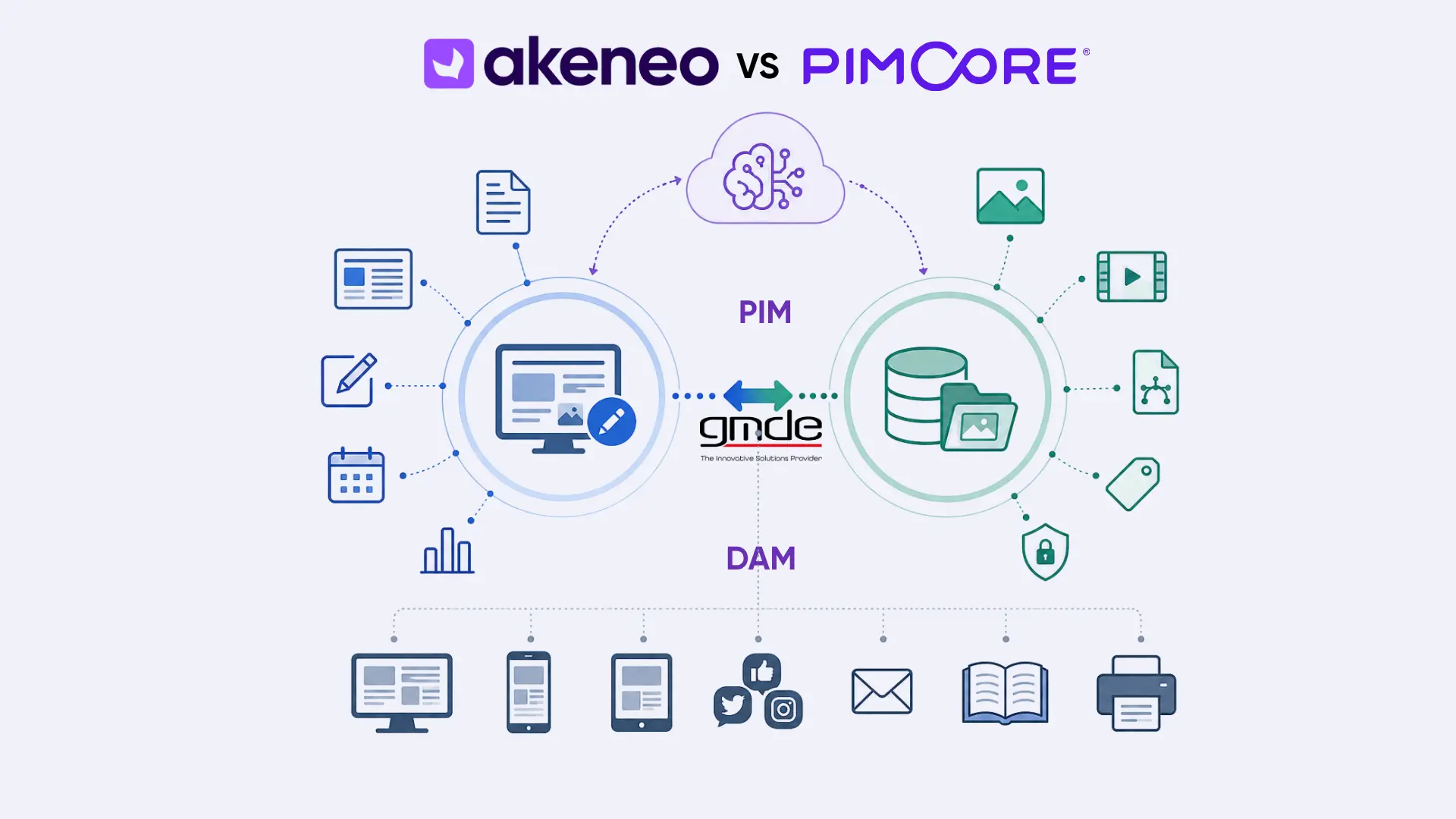
When a company decides to adopt a Product Information Management (PIM) platform, a comparison between Pimcore and Akeneo is almost inevitable. Both platforms allow businesses to centralise, enrich and distribute product information, have an established presence in the European market and share a modern technological approach. However, the similarities end there. Akeneo was designed as a specialised solution focused on product information management. Pimcore places PIM within a broader Product Experience Management (PXM) platform, where product data, master data, images, documents, web content and digital experiences can coexist. The choice therefore cannot depend solely on licence costs or brand recognition.
A company looking to speed up catalogue enrichment has different needs from an industrial manufacturer that must connect products, components, spare parts, certifications, images and technical documentation. Likewise, distributing product information to a few marketplaces is not the same as supplying e-commerce websites, B2B portals, printed catalogues, apps and configurators simultaneously.
The question therefore becomes more specific. Do you need a PIM focused on your commercial catalogue, or a platform capable of organising a more comprehensive and dynamic information ecosystem, supporting both catalogue and price list creation and the wider management of product information?
Two different approaches to PIM
Pimcore takes a best-of-suite approach, bringing several functions together within the same ecosystem. PIM is part of a modular environment that also includes Digital Asset Management (DAM), Master Data Management (MDM), CMS/DXP and Digital Commerce capabilities. The system therefore goes beyond organising a catalogue: it can connect information, assets and content from different business departments.
This approach also allows projects to scale over time. Companies can start with PIM and/or DAM, or even the web CMS, and gradually introduce further capabilities to achieve comprehensive product information management. They can do so without disruptive transitions or the need to select additional platforms and integrate them into their existing systems.
Akeneo, by contrast, follows a best-of-breed approach, connecting specialised software solutions. Its interface has been a key strength, particularly before the release of Pimcore Studio. It guides users through catalogue enrichment tasks and makes missing data immediately visible. Descriptions, attributes, translations and content for different channels can be managed in an environment designed primarily for the everyday work of marketing and e-commerce teams.
This distinction does not mean that one approach is always preferable to the other. Rather, it reflects two different ways of building a digital architecture. In the best-of-breed model, each application performs a specific function and communicates with other systems through APIs and connectors. In the best-of-suite model, several functions are coordinated within the same platform, while retaining the ability to integrate with ERP, PLM, CRM, e-commerce and external applications.
Pimcore and Akeneo in everyday business processes
A list of features helps explain the technical differences, but does not always show how they affect everyday work. It is more useful to start with practical scenarios and consider how requirements change.
|
Business need or scenario |
Akeneo |
Pimcore |
What to assess |
|
Retail catalogue with sizes, colours, materials and collections |
Provides an intuitive environment for enriching product information and checking completeness. Some limitations emerge as products and their variations become more complex. |
Can handle the same scenario, while offering greater flexibility for complex projects. The interface preceding Studio is not always intuitive. |
Consistency of the catalogue structure |
|
Product distribution to retailers and marketplaces |
Particularly focused on activating and syndicating commercial product information. |
Can distribute data to multiple channels through APIs and project-specific integrations. |
Number and types of channels to supply |
|
Industrial catalogue with numerous technical variants |
Can manage extensive catalogues, while maintaining a strong focus on product information. |
Supports complex relationships between products, components, attributes and documents. |
Complexity of the data model |
|
Machinery, serial numbers, exploded views and compatible spare parts |
Requires careful assessment of the data model and necessary integrations. |
Can represent objects and relationships that extend beyond a conventional product record. |
Technical data and after-sales requirements |
|
Management of images, videos, manuals and certifications |
Offers asset management capabilities that vary according to the selected offering. |
Includes a DAM that connects assets directly to data and other business objects. |
Volume, variety and reuse of files |
|
An established DAM, CMS and e-commerce platform already in place |
Can serve as a specialised PIM within the existing ecosystem. |
Can replace or integrate some existing systems, depending on the architectural design. |
Balance between existing applications and new requirements |
|
Creation of catalogues, price lists and technical data sheets in InDesign |
Requires integration with dedicated external tools or connectors. |
Can supply data to automated publishing workflows based on InDesign and Smart InDesign. |
Importance of printed materials in business processes |
|
B2B portal with content tailored to customers or markets |
Can supply product information to the portal. |
Can manage portal data, documents and content within a broader ecosystem. |
Required level of experience personalisation |
|
Rapid adoption by the marketing team |
Its enrichment-focused interface supports a more immediate start. |
Requires configuration and onboarding aligned with the complexity of the project. |
Number of users, roles and tasks |
|
Extensive customisation of data structures and the backend |
Options depend on the edition and the constraints of the chosen architecture. |
Offers substantial freedom in data modelling and customisation. |
Required degree of autonomy and flexibility |
The comparison shows that complexity is not simply a matter of product numbers. A catalogue containing a few hundred items can be difficult to manage if each one is connected to numerous variants, components and documents. Conversely, thousands of products following a consistent structure can be managed through a relatively straightforward model.
Akeneo’s strengths
Akeneo is well suited to companies looking for a specialised PIM with a user experience designed around the teams responsible for completing and publishing the catalogue. The system helps identify missing information and prepare consistent content for different languages, markets and channels.
This approach is particularly effective in retail and B2C, where products often follow recurring structures. Sizes, colours, materials and collections can be organised into relatively consistent families and attributes. Marketing teams work on descriptions and commercial information, while the platform supports the enrichment process.
Akeneo can also be a suitable option when a company already has a DAM, CMS and e-commerce platform that meet its needs. In this context, PIM has a clearly defined role and fits into the architecture through APIs, middleware and connectors.
However, initial simplicity should not be assessed separately from future development. Before choosing a platform, companies need to establish whether the catalogue will remain straightforward or will eventually include new relationships, technical documents, after-sales services or additional types of data.
Pimcore’s strengths
Pimcore delivers its full potential when product information needs to be distributed across multiple channels simply and directly, and/or forms part of a more complex information environment, as is often the case in industrial companies.
A machine, for example, is not described solely by a name, an image and a few commercial features. It may include numerous components, be available in different configurations and require specific spare parts. Manuals, certifications, exploded views, technical data sheets and multilingual documents add further information, all interconnected and subject to frequent updates.
These materials need to maintain precise relationships. The right spare part must be associated with the compatible machine, documentation must match the relevant model, and distributors must be able to access up-to-date files for their market.
Pimcore allows companies to build a data model that reflects this reality. Products, components, assets and documents can be managed as connected objects, avoiding the need to reduce the entire information environment to a series of independent product records.
The platform can also receive data from ERP and PLM systems, supplement it with information produced by marketing and distribute it to business channels. It does not necessarily replace all existing systems, but can become the point where information from different sources is harmonised and prepared for use.
DAM extends the value of PIM
The quality of a product page depends on more than text and technical specifications. Images, videos, renderings, certifications, manuals and PDF data sheets complete the information and make it usable across different channels.
When these assets are scattered across shared folders, personal computers and separate archives, finding the right file takes longer and increases the risk of publishing outdated versions. Management becomes even more complex when different languages, markets and formats are involved.
In Pimcore, DAM is natively integrated with PIM. Product data and digital assets are therefore managed in the same environment and connected within a single information model. An image, manual or certification can be linked directly to the relevant product, category or component, without separate repositories or additional integrations.
When a file is updated, the new version remains linked to the same objects and can be distributed to the relevant channels without manually rebuilding those associations. The same asset can also be organised, transformed and made available in different formats according to its destination, from websites and e-commerce platforms to B2B portals and catalogues.
Akeneo also offers digital asset management capabilities, with features that vary according to the selected edition. The difference therefore lies not simply in whether DAM is available, but in its role within the architecture. In Pimcore, PIM and DAM belong to the same platform, allowing data, images and documents to be managed as connected elements of a unified information environment.
From PIM to catalogue, without starting from scratch each time
The difference between the two platforms becomes even clearer when a company produces printed catalogues, price lists and technical data sheets. In many organisations, these documents are updated by manually transferring content from Excel, ERP systems or databases into InDesign. The process requires numerous checks, and each change can lead to further work on pages that have already been laid out.
GMDE integrates Pimcore with publishing workflows based on Adobe InDesign. Data held in the PIM automatically populates the document, while the graphic designer retains control over the visual layout.
The benefit lies in reusing the same information without duplicating it or repeatedly copying and pasting content, while preserving the freedom to design the catalogue. The same data can supply the website, e-commerce platform, restricted-access portal and printed publication. The format changes; the source stays the same. Consistency across channels becomes a result of the process, rather than depending on manual checks at the end.
A technology platform requires the right expertise
A broad range of features is not automatically an advantage. An extensive platform requires analysis, configuration and appropriate expertise. If a company simply needs to centralise a straightforward catalogue and make enrichment easier, introducing a broader architecture may add unnecessary complexity.
The reverse is also true. A system that is immediately easy to use may become restrictive as the project grows to involve technical data, assets, workflows, portals and documents. At that point, the company may need to add applications, develop further integrations or revise its original model.
The choice should take into account the total cost of the project over time. Beyond subscription or licence fees, this includes implementation, integrations, data migration, maintenance and the possible introduction of complementary systems. An assessment limited to the initial price cannot capture these differences.
Get organised before choosing the software
A PIM does not automatically fix incomplete information, inconsistent classifications or unclear responsibilities. If a project simply transfers the existing spreadsheet structure into the new system, many of the same problems will persist in a different form.
Before implementation, companies need to map the data journey. They must establish which system generates each piece of information, who can modify it, who must approve it and which channels will use it. Only after this analysis can the data model, workflows and integrations be defined.
The system integrator plays a decisive role here, going beyond platform installation to translate business processes into a sustainable architecture. Effective design allows marketing, IT, engineering and sales teams to work from the same information base while retaining their distinct responsibilities.
Pimcore or Akeneo: the answer lies in your processes
Akeneo is the more practical choice when the objective is to optimise commercial catalogue preparation, prioritise the user experience of marketing teams and quickly supply retail channels with simple products organised in a straightforward catalogue.
It is particularly suited to companies seeking a ready-made solution and willing to work within its strengths and limitations. The platform offers substantial capabilities, but these may become restrictive during a later phase of growth, when the original setup no longer meets the company’s needs.
Pimcore is better suited to projects where PIM needs to connect with master data management, digital assets, web content and documents. Its flexibility is particularly relevant in industrial and B2B environments, where products are linked to technical data sheets and commercial information.
The aim is to find the solution that can support the company’s processes without forcing operational compromises.
Choosing a PIM starts with listening
Before recommending the right technology for your business, GMDE analyses how your company works and what you want to achieve by adopting these solutions.
We offer more than another application to add to your business, and we do not promise miracles in two clicks. We are committed to delivering a solution that integrates seamlessly with your existing systems, creating a unified, collaborative ecosystem for producing, managing and distributing all product information across current and future channels.
Contact us for a free consultation on your business processes!
FAQ
What is the main difference between Pimcore and Akeneo
Akeneo focuses on managing and enriching product information, with a user experience designed for marketing and e-commerce teams. Pimcore integrates PIM into a broader platform that also includes DAM, MDM and content management. The main difference therefore lies in the platform’s role within business processes: a specialised PIM or an ecosystem connecting product data, digital assets and other information.
Are Pimcore and Akeneo open source?
It is necessary to distinguish between editions and licences. Akeneo Community Edition is free and open source, while its commercial offerings have different features and terms. Since version 2025.1, Pimcore has used the Pimcore Open Core License (POCL): its source code is available, but usage is subject to specific conditions, so it should not be equated with a traditional open-source licence. Free use of the Community Edition depends on meeting the licence requirements.
Can Akeneo also manage images and documents?
Yes. Akeneo allows images and files to be associated with product information and offers tools for managing assets such as videos, manuals and PDF documents. Available features depend on the selected edition and offering. The difference compared with Pimcore primarily concerns the architecture: in Pimcore, DAM is integrated into the same platform as PIM and can also link assets to other business objects and data.
Can you migrate from Akeneo to Pimcore?
Yes, but migration requires a structured project. The existing model needs to be analysed, with families, attributes, variants, translations and assets mapped to the data model defined in Pimcore. Integrations with ERP systems, e-commerce platforms and other channels also need to be reconfigured. The timeline and complexity depend on data quality, customisations and the systems involved. Migration can also provide an opportunity to review processes and improve how information is organised.