

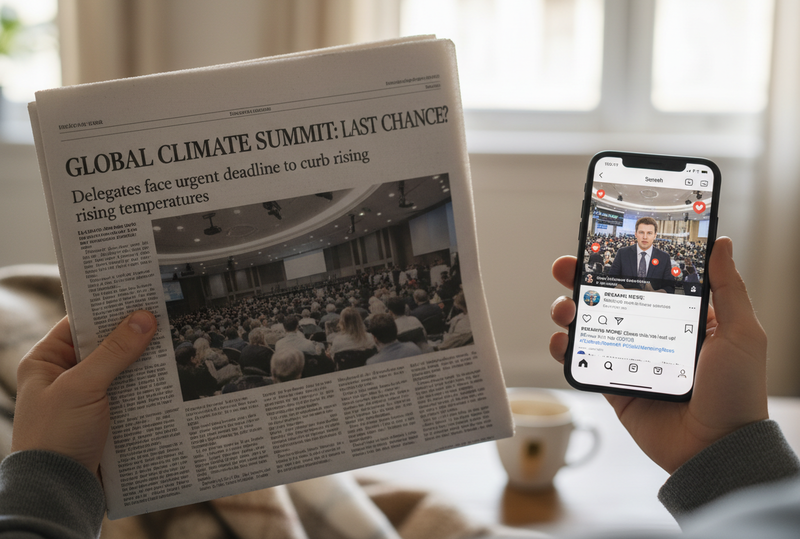
The Community Talk “Between Social and AI: How Is the Relationship with Users Evolving?” organised by the Digital Content Observatory of the Politecnico di Milano – in which GMDE took part as a research partner – offered a very clear snapshot of the moment publishers are experiencing: a highly competitive market that demands increasingly personalised and high-performing strategies.
The multiplication of touchpoints, the growing infidelity of users, and the rising costs of acquisition and retention make the relationship with readers the key driver shaping loyalty, monetisation, and the ability to stand out within an increasingly crowded ecosystem.
According to the Observatory’s analysis, social media continue to play a significant role in users’ media diets, though with dynamics that should not be underestimated. On the one hand, they remain the primary space for stimulating interaction and participation; on the other, they have become a decisive lever in the content discovery phase, as feed algorithms now have a major impact on what users actually see.
A substantial share of consumption choices stems from what appears, is recommended, reviewed, or highlighted during social scrolling – a dynamic that affects all generations, albeit with different intensities. Yet this is precisely where the deepest transformation is taking place. Social platforms are gradually abandoning their “community-based” nature in favor of something far more personal. They are moving towards AI-generated feeds, built ad hoc for each user and capable of anticipating what they will want to see before they even search for it.
Engagement no longer arises from dialogue with other people, but from a private and silent form of consumption guided by predictive models that turn scrolling into a continuous, passive experience. In this context, the community loses importance, and the user’s relationship no longer passes through a social environment but through an individual bond with the algorithm.
The Observatory’s data confirms this trend:
• 59% of users agree that reading posts or news excerpts on social media leads them to search for the full article online, while 42% disagree.
• 51% agree that reading book quotes on social media prompts them to look for the e-book, while 49% disagree with this behaviour.
At the same time, online search is undergoing a radical shift. With tools such as Google AI Overview and ChatGPT Atlas, users no longer interact with the publisher’s page but with a synthesised, AI-adapted version of the content. They no longer search for the full text but request a summary, which they often obtain without ever accessing the original website. In this mode of consumption, AI becomes the primary intermediary between publisher and audience, reducing the brand’s ability to convey its identity, authority, and editorial style.
All of this creates challenges that publishers can no longer postpone. The first concerns the ability to maintain a direct connection with readers in a context where platforms and generative systems tend to filter, reinterpret, and in some cases replace original content. Strengthening proprietary assets and building an experience capable of retaining users – offering value, personalisation, and concrete reasons to return – becomes essential. At the same time, publishers must develop content that can be understood and enhanced by new AI systems, without losing editorial coherence or narrative quality.
Personalisation becomes a key asset, and the publishing sector is called upon to integrate it into catalogues, recommendation systems, workflows, and format design.
It was also highlighted that younger generations discover content through hybrid dynamics, where TikTok and vertical social platforms influence consumption just as much as if not more than, traditional editorial platforms. This forces publishers to rethink their presence, languages, and distribution methods, not as occasional adaptations but as structural components of their strategy.
In this increasingly AI-driven context, GMDE supports publishers by offering solutions designed to simplify internal workflows, optimise content adaptation, and at the same time strengthen the direct bond with their audience. Integrated ecosystems enable the coherent management and orchestration of content across all touchpoints, personalise the user experience, and ensure that editorial infrastructures remain competitive.
The real challenge is not resisting change, but steering it effectively – shaping an editorial experience that remains recognisable, authoritative, and flexible; one that can dialogue with new algorithms without losing its identity and can guide readers through a digital ecosystem that evolves every day.
Get in touch and tell us about your project!
The customers with whom GMDE works daily are more than 100 and... they are all satisfied
See more






GMDE has got those certifications and partnerhips