


In traditional packaging, much is said about sustainability, alternative materials, European regulations and cost reduction. All of this is relevant. Yet there is a less visible factor that directly affects quality, margins and production continuity: Prepress technology.
Those working in corrugated board, folding cartons or display units know that the final result does not originate on the printing press. It starts earlier. It begins with the precision of the halftone dot engraving, the consistency of laser exposure and the plate’s ability to maintain stability over long print runs and complex substrates.
Today, CTP (Computer-to-Plate) is no longer merely a technical peripheral. It is a fundamental driver.
A transforming sector: why the context makes CTP selection strategic
The packaging industry in Italy is undergoing a structural evolution. New European directives - from the PPWR Regulation to recyclability standards - require every package to be designed according to reuse or recycling principles. Design is no longer solely about aesthetics or product protection; it has become “design for recycling”.
At the same time, reducing single-use materials and overpackaging is not just an environmental issue — it is an economic lever. In e-commerce, weight and volume directly impact logistics costs. In food and retail, replacing plastic with alternative solutions demands new materials and new printing approaches.
The spread of mono-materials and the increased use of recycled components alter substrate behaviour: absorption, colour rendering and dot stability all change. This means prepress must deliver even tighter control. Meanwhile, packaging has also become a data carrier. Dynamic QR codes, serialisation, mandatory environmental labelling and the DPP (Digital Product Passport) require precision, variable data management and total reliability. An error is no longer merely technical — it may become regulatory.
Added to this is margin pressure. Rising raw material costs and fiscal impact are driving automation and workflow optimisation. Reducing waste, makeready times and press downtime is not an incremental improvement; it is a competitive necessity.
In this complex scenario, CTP technology becomes the balance point between sustainability, quality and productivity.
When prepress becomes a real competitive advantage
In industrial packaging, every minute lost during makeready means wasted board, ink and unproductive press time. The difference between a stable plate and one requiring constant adjustments translates directly into efficiency.
On large formats and corrugated board — where abrasion levels are high and inks may be aggressive (such as UV and special varnishes) — dot precision is critical. Even minimal variation can be amplified across the entire print run. For this reason, the choice of exposure technology is far from neutral.
SLM thermal technology: industrial uniformity and stability
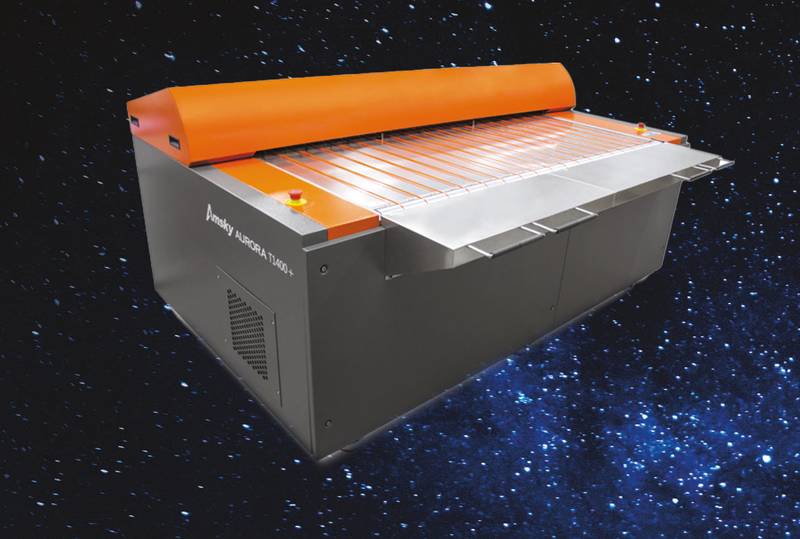
Among the most advanced solutions is AMSKY’s SLM (Spatial Light Modulator) thermal technology (read more). Unlike traditional multi-diode systems, SLM technology uses a thermally modulated laser source that ensures uniform exposure across the entire plate surface.
This guarantees dot consistency even on Very Large Format sizes typical of packaging and corrugated applications. The result is not merely improved graphic definition. It means greater on-press stability: fewer adjustments, more consistent colour and long print runs without quality degradation.
In an industrial context, this stability is what transforms technical quality into tangible productivity.
Why chemically processed plates remain a strategic choice in packaging
Although much is said about process-less solutions, in industrial packaging durability remains the priority. Chemically processed plates still offer superior polymer cohesion, better performance with UV inks and complete cleanliness of the dampening system.
For those working with corrugated board or abrasive substrates, production continuity outweighs the elimination of the processor. Integrating advanced thermal technology enables exceptionally high-quality imaging today, while maintaining flexibility for future developments.
ROI in packaging: beyond the cost of chemistry
Assessing a CTP system solely in terms of consumables savings is reductive. In packaging, return on investment is measured through more strategic parameters: reduced makeready times, less waste, greater colour stability and the elimination of Prepress bottlenecks.
A press operating continuously generates value. A press waiting for a plate or requiring constant corrections generates invisible costs.
This is why choosing the right thermal technology directly impacts profitability.
Integrated technology, not isolated replacement
Introducing or replacing a CTP system is not a simple hardware upgrade. It is a structural intervention in the production workflow. It requires analysing average print runs, materials, ink types, workflow integration and impact on the pressroom.
For years, GMDE has supported packaging companies in this strategic evaluation, assisting them in selecting and integrating advanced thermal CTP solutions capable of genuinely improving stability and productivity.
In traditional packaging, speed matters. Stability matters more.
Would you like to assess whether your current technology is still competitive, or are you considering a change?
Contact us with no obligation and speak with a dedicated consultant.
The customers with whom GMDE works daily are more than 100 and... they are all satisfied
See more










GMDE has got those certifications and partnerhips