

In the publishing world, time is increasingly scarce and complexity is growing. It is within this context that the evolution of WoodWing,’s solutions takes shape, with an ever-stronger focus on integrating artificial intelligence, automation, and collaboration across the entire publishing value chain. After illustrating how AI-powered features are already transforming the production of magazines and educational content, the innovations announced for 2026 mark a further step forward. These are not merely technological updates, but a concrete strengthening of the publishing ecosystem, designed to support publishers, editorial teams, and creative departments in their day-to-day work.
An integrated publishing ecosystem, from creation to distribution
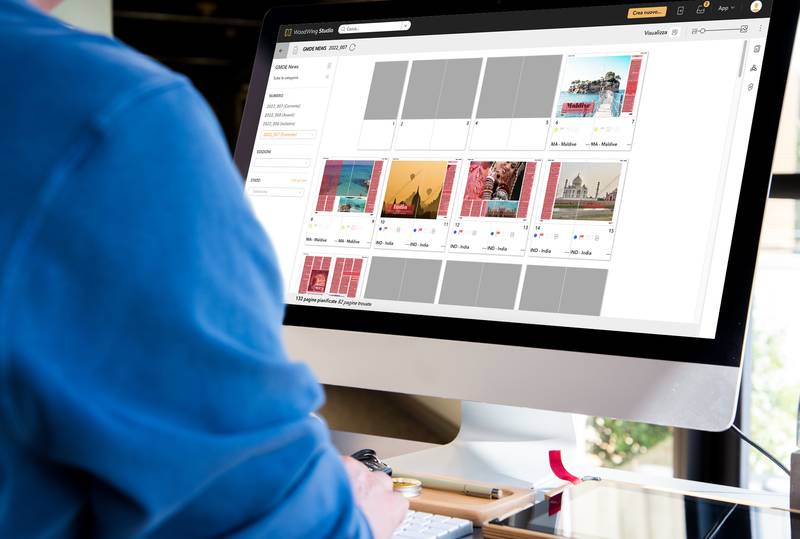
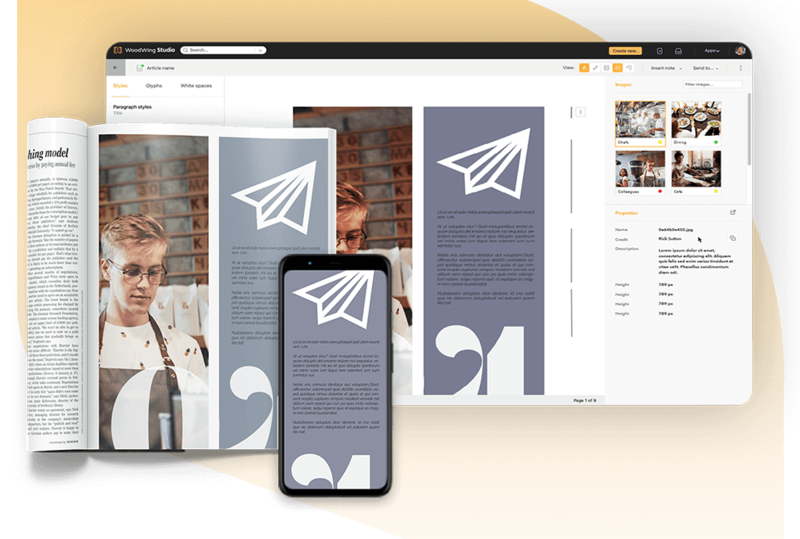
The WoodWing solution suite covers the entire content lifecycle. WoodWing Studio is the core of editorial production, enabling journalists, editors, and designers to collaborate in real time on articles and layouts, managing versions, comments, and approvals within a single environment, and publishing the same content across print, web, and digital channels. Within WoodWing Studio Smart Styles plays a key role: a plugin that simplifies and speeds up layout work in Adobe InDesign by allowing consistent, standardized design styles to be applied across documents.
WoodWing Assets, on the other hand, is the system that manages images, videos, and multimedia materials, ensuring order, discoverability, and control even within very large archives. The true value of this ecosystem lies in its integration: each solution communicates with the others, reducing operational friction and making editorial workflows more streamlined and easier to manage.
WoodWing Assets: from DAM to an operational hub for editorial teams and designers
With the new release of WoodWing Assets 10, the DAM (Digital Asset Management) evolves from a simple archive into a true workspace. The new interface, combined with the introduction of a video editor and a design editor directly within the platform, allows users to work on content without leaving the DAM. This means fewer tool switches, fewer duplications, and greater speed—especially for editorial teams managing multiple projects in parallel. Mobile-friendly sharing features make content instantly accessible even outside the office, while comments, mentions, and the Workflow Assistant introduce a new level of coordination that turns Assets into a central collaboration hub, not just a storage system. For publishers, the result is greater control over assets and a significant reduction in repetitive tasks.
WoodWing Studio: with AI layout automation, automation truly enters production
One of the most significant developments concerns AI-based layout automation. Through blueprints and article shapes—intelligent templates that define page structures and modular graphic components derived from previously published layouts and capable of automatically adapting to content—the algorithm can generate complete pages while respecting editorial hierarchies, graphic constraints, and predefined advertising spaces. Alongside automatic page generation, WoodWing is also working on AI copy fitting applied to layout. In this case, artificial intelligence does not alter journalistic text, but intervenes solely on graphic arrangement. It is a concrete support for designers’ work, drastically reducing layout times without compromising quality or editorial identity.
WoodWing Studio: the Content Delivery Hub for seamless collaboration and consistent distribution
WoodWing Assets 10 continues to evolve on the collaboration front. The introduction of comments with hyperlinks makes the exchange between editorial and design teams more precise and contextual, while advanced version management prevents information loss and unnecessary revisions throughout the production process. The Content Delivery Hub further strengthens the link between production and distribution, acting as a central layer that collects content created in Studio and makes it available— in a structured and automated way—across different output channels such as websites, apps, digital platforms, and external systems. This allows publishers to distribute the same content across multiple touchpoints while maintaining consistency, control, and rapid updates—an increasingly strategic capability in a landscape where channel fragmentation has become the norm.
A competitive advantage for publishers, today
These innovations respond to a very real challenge: building a publishing model capable of withstanding the impact of generative AI, informational chatbots, and the so-called “Google Zero,” without losing control over content, data, and the relationship with readers. The goal is not to produce more, but to produce better—through sustainable workflows and consistently high quality over time.
GMDE, WoodWing’s reference partner in Italy, has been supporting publishers on this journey for years, integrating solutions into existing processes and translating technological innovation into tangible operational benefits.
Want to understand how these innovations could apply to your publishing project?
Let’s set up an introductory call. You tell us about your needs, and we’ll propose the right solution for you.
Source: WoodWing
The customers with whom GMDE works daily are more than 100 and... they are all satisfied
See more






GMDE has got those certifications and partnerhips